Stopping AI-Generated Architectural Drift: Deterministic Guardrails for Agentic Coding
Stopping AI-Generated Architectural Drift: Deterministic Guardrails for Agentic Coding by Sasha Podlesniuk
Room 8 · Tools-in-Action · 17:35-18:05
Summary
Section titled “Summary”This talk explains how to prevent AI-generated code from spreading architectural violations by using layered guardrails. It shows why natural-language rules fail, and how deterministic enforcement with ArchUnit, custom linters, and CI gates can stop bad patterns immediately and make higher-level rules effective.
Key points ⭐
Section titled “Key points ⭐”- 03:41 error pron, java check like arch unit
Timeline
Section titled “Timeline”
- error pron
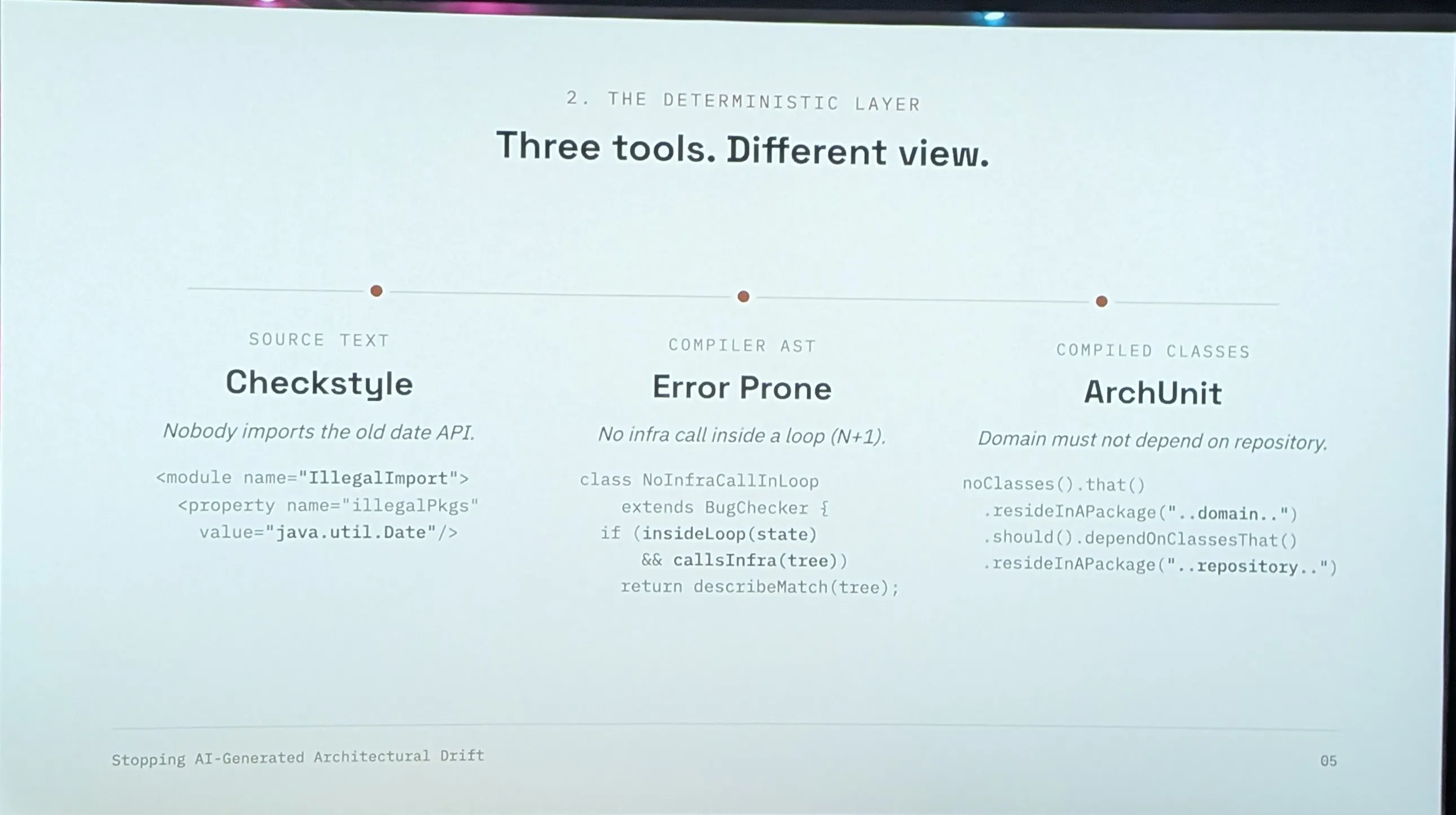
- java check like arch unit
Extra notes
Section titled “Extra notes”https://www.youtube.com/@AriKuschnir
Both do static analysis of Java code, but they don’t work at the same moment, at the same level, or on the same kind of problem. They are complementary.
ArchUnit: checking the architecture
Section titled “ArchUnit: checking the architecture”ArchUnit is a test library. You write architecture rules as JUnit tests, which run during the test phase. It analyses the compiled bytecode (the .class files) and builds a graph of all classes and their dependencies. So it has a global view of the codebase: who depends on whom, which packages call each other, which annotations are where.
Typical questions are structural:
- “The service layer must never call the web layer.”
- “No cycles between packages.”
- “Classes annotated
@Statelessmust live in..ejb...” - “Nobody uses
java.util.Dateoutside the legacy module.”
@ArchTeststatic final ArchRule services_ne_dependent_pas_du_web = noClasses().that().resideInAPackage("..service..") .should().dependOnClassesThat().resideInAPackage("..web..");A big asset for a monolith: FreezingArchRule. It records the existing violations as a baseline and only fails the build on new ones. So you can enforce a rule on legacy code without fixing everything first.
Error Prone: finding bugs in the code
Section titled “Error Prone: finding bugs in the code”Error Prone, developed by Google, is a plugin for the javac compiler. It runs during compilation and analyses the AST (syntax tree) of each source file. Its view is local and fine-grained: it looks at expressions, method calls and precise types, but file by file, with no overall view of the architecture.
Typical questions are about programming mistakes:
String.formatwith a number of arguments that doesn’t match the pattern;- ignored return value (
str.trim();on its own); equalsbetween incompatible types;- non-exhaustive
switch, misuse ofOptional, concurrency problems, etc.
String s = "abc";s.replace("a", "b"); // Error Prone: ReturnValueIgnored → compilation errorIt often suggests an automatic fix (patch) and is the base for other tools, like NullAway for nullability. Writing your own checks with the BugChecker API is possible, but much more complex than an ArchUnit rule.
In short
Section titled “In short”| ArchUnit | Error Prone | |
|---|---|---|
| Nature | Test library | javac compiler plugin |
| When | Test phase | Compilation |
| Analysis | Bytecode, global graph | Source AST, local per file |
| Target | Architecture rules and conventions | Bugs and bad code patterns |
| Custom rules | Easy (fluent Java DSL) | Possible but more technical |
| Legacy | Native freeze / baseline | Disable per check or suppression |
The simple rule: ArchUnit answers “is this code in the right place and does it respect the intended structure?”, Error Prone answers “does this code do what the developer thinks?” On a Java EE monolith, the two together cover the ground well.
Setup-wise, ArchUnit is trivial to add (one test dependency). Error Prone needs more configuration of the maven-compiler-plugin. Since JDK 16 you also need --add-exports / -J--add-opens flags, and you must check the compatibility between the Error Prone version and the JDK version.